
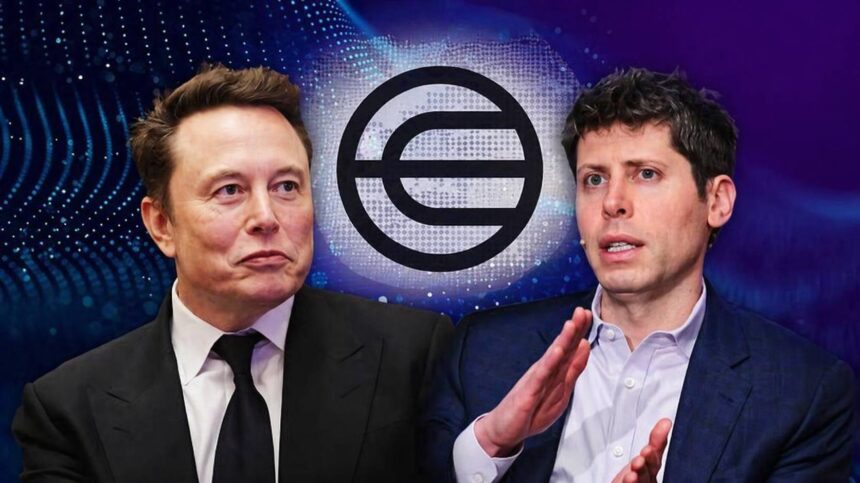
San Francisco, April 28, 2026 — In the ever-escalating tech rivalry between Elon Musk and Sam Altman, a new bit of sharp wordplay has surfaced. Online reports and circulating posts suggest Musk has privately referred to Altman’s ambitious biometric cryptocurrency project, Worldcoin, as “WorldCon” — a concise jab that implies the venture is less a bold solution for the AI age and more a sophisticated confidence game.
The nickname emerged this week amid renewed public focus on Musk’s high-stakes lawsuit against OpenAI, where the Tesla and xAI founder accuses his former collaborator of betraying the company’s founding nonprofit mission in pursuit of profit. While no verified public statement or transcript attributes the exact term to Musk, “WorldCon” has quickly gained traction in crypto forums and meme circles as a succinct expression of longstanding skepticism toward Worldcoin’s iris-scanning model.
“WorldCon captures the criticism in one word,” noted one prominent crypto commentator in a widely shared post. “Is it essential global identity infrastructure for an AI-saturated future — or just a high-tech confidence game?”
The Vision Behind the Orb
Launched by Tools for Humanity and co-founded by Altman, Worldcoin centers on its distinctive hardware: the Orb, a polished spherical device that scans users’ irises to create a unique “World ID.” Participants receive Worldcoin’s native token, WLD, in exchange for the scan. The project’s stated goal is ambitious — to establish a decentralized, privacy-focused system for verifying human identity at global scale.
In an era of rapidly advancing generative AI, where distinguishing real humans from bots and deepfakes grows increasingly difficult, proponents argue such proof-of-personhood technology could become foundational. Potential applications range from fair distribution of universal basic income (UBI) to securing online voting, preventing sybil attacks in decentralized networks, and ensuring genuine human participation in AI-governed economies.
Altman has positioned Worldcoin as a humanitarian counterweight to AI disruption: a way to ensure that real people retain economic value and agency as machines grow more capable. The company has deployed Orbs in dozens of countries, enrolling hundreds of thousands — and at times claiming ambitions for billions — of verified humans.
Privacy Backlash and Regulatory Setbacks
Yet the project has faced persistent and often fierce criticism. Privacy advocates warn that collecting immutable biometric data like iris patterns creates irreversible risks. Unlike passwords or credit cards, irises cannot be changed if compromised. Concerns about data security, informed consent, and potential surveillance have dogged Worldcoin since its early days.
The most notable flashpoint occurred in Kenya. In 2023, the government suspended Worldcoin operations amid accusations of unlawful data collection. A High Court later ruled that Tools for Humanity violated Kenya’s Data Protection Act by failing to conduct a required Data Protection Impact Assessment and by obtaining consent through financial inducement — offering crypto tokens in exchange for scans. In early 2026, the company complied with orders to permanently delete all biometric data collected from Kenyan citizens, a significant operational and reputational blow.
Similar scrutiny has played out elsewhere. European regulators have examined potential GDPR compliance issues around explicit consent and cross-border data transfers. Ethereum co-founder Vitalik Buterin has publicly voiced technical concerns, including the risk that centralized elements within the system could allow creation of fake identities. Reports of aggressive enrollment tactics in emerging markets have further fueled accusations of exploitation.
These issues have given the “WorldCon” label particular resonance.
It frames Worldcoin not as a noble technological breakthrough but as another example of Silicon Valley overreach — promising utopian outcomes while harvesting sensitive personal data from populations least equipped to understand the long-term implications.
A Philosophical Clash
The timing amplifies the narrative. Musk’s legal battle with OpenAI, now unfolding in court, centers on fundamental questions about AI development: Should the technology remain open and mission-driven, or is a for-profit path inevitable? Musk has long warned about the dangers of concentrated AI power and has expressed broader discomfort with expansive biometric collection, citing risks to individual liberty and potential authoritarian misuse.
Though Musk has not publicly confirmed using the “WorldCon” phrasing, it aligns with his history of blunt, meme-infused commentary on competing ventures. Online communities have paired it with quips like “Scan Altman,” turning the Musk-Altman feud into a broader cultural proxy war over visions of the future: cautious decentralization versus rapid, centralized innovation.
Some observers see the conflict as emblematic of deeper Silicon Valley fault lines — accelerationism versus restraint, open-source ideals versus proprietary control, and differing assessments of how quickly AI will reshape society.
No Comments, Lingering Questions
Neither Musk nor Worldcoin representatives have publicly addressed the nickname. Musk has previously voiced general reservations about projects like Worldcoin, but the specific pun remains in the realm of internet lore.
In the attention-driven tech landscape, however, such labels often carry outsized influence. They can shape investor sentiment, color regulatory perceptions, and linger in public memory long after official denials or clarifications. “WorldCon” joins a short but potent list of meme-born tech critiques that manage to distill complex debates into something sticky and shareable.
As AI capabilities continue their steep trajectory, the underlying questions Worldcoin raises will only grow more urgent: How should humanity verify identity in a world of convincing synthetic content? Who should control the resulting biometric databases? And what safeguards are sufficient when the data in question is literally part of a person’s body?
Worldcoin represents one high-profile, high-risk attempt to answer those questions at planetary scale. Its technical architecture, tokenomics, and privacy mitigations — including zero-knowledge proofs — continue to evolve. Yet trust remains the scarcest resource. Once biometric sovereignty is surrendered, it is difficult to reclaim.
With Musk and Altman’s courtroom drama providing fresh oxygen to their philosophical differences, the “WorldCon” moniker is likely to circulate for some time. Whether it fades as fleeting online snark or hardens into a lasting cultural shorthand may depend on how Worldcoin navigates its next chapter of regulatory, technical, and ethical challenges.
In the end, the real contest extends far beyond any single nickname. It is about competing blueprints for a future in which artificial intelligence reshapes not just economies and labor markets, but the very notions of identity, agency, and what it means to be verifiably human.