
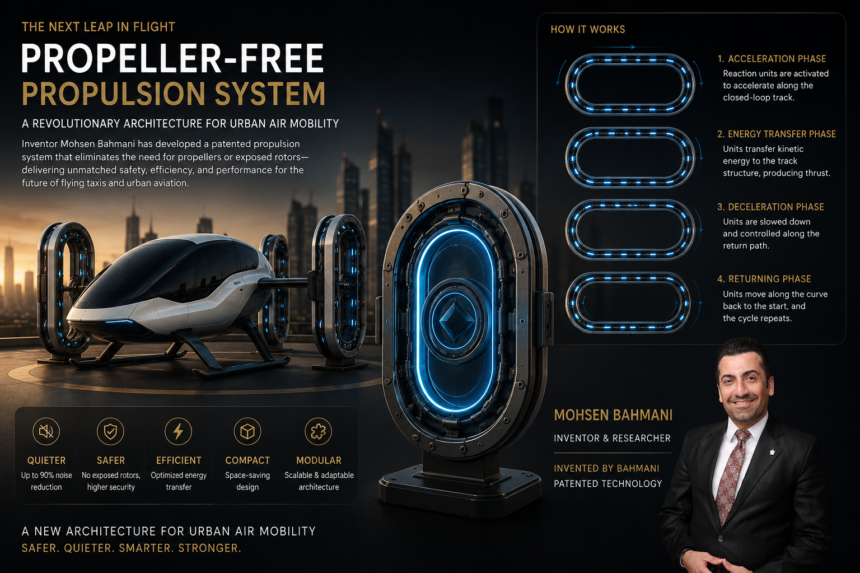
In the history of engineering, transformative ideas often begin at the margins ideas initially perceived as unconventional before becoming part of mainstream technological evolution. German-Iranian inventor Mohsen Bahmani represents a figure shaped by precisely that kind of trajectory.
Long before entering the discussion around next-generation propulsion systems, Bahmani first attracted international attention as a teenager through an invention that captured both public imagination and media curiosity: the so-called “Floating Shoes,” a concept intended to enable movement across water surfaces. Inspired, according to biographical accounts, by disaster-response thinking and emergency rescue scenarios, the invention brought him early recognition, international awards, and appearances in European media.
For many young inventors, such early visibility becomes a singular moment. For Bahmani, it appears to have been merely a starting point.
After relocating to Germany and pursuing studies in mechanical engineering at the Karlsruhe Institute of Technology (KIT), his work evolved from conceptual mobility inventions toward more technically ambitious engineering systems. That transition is particularly visible in his latest propulsion concept an architecture that departs sharply from the propulsion principles that have defined aerospace engineering for more than a century.
At the center of this proposal is a question increasingly relevant to advanced mobility industries:
Can propulsion be achieved without relying on conventional external propellers or traditional jet-based architectures?
Bahmani’s recent patented concept suggests one possible alternative.
Rather than generating thrust through exposed rotating blades or direct exhaust propulsion in conventional form, the proposed system explores a propulsion architecture built around internally controlled reaction mechanisms operating within a closed-loop motion framework. In essence, thrust generation is approached through orchestrated cycles of acceleration, momentum transfer, and force redistribution inside a dynamically engineered system.
While unconventional at first glance, the concept is positioned not as a “reactionless drive” or speculative physics-defying proposal, but as an engineering framework rooted in classical mechanics and momentum transfer principles. That distinction is crucial, as alternative propulsion concepts often face immediate skepticism due to associations with scientifically questionable claims. In Bahmani’s case, the proposal explicitly situates itself within known physical laws rather than outside them.
What makes this concept particularly relevant is timing.
The aerospace and mobility sectors are entering a period where conventional propulsion systems are increasingly being reassessed. Electric vertical takeoff and landing aircraft (eVTOLs), autonomous drones, advanced air mobility platforms, and even specialized defense applications all face persistent engineering constraints: rotor noise, exposed mechanical complexity, maintenance demands, aerodynamic inefficiencies, and limitations in energy optimization.
For decades, engineering progress in propulsion has largely focused on incremental refinement lighter materials, more efficient turbines, smarter battery integration, quieter rotors. Yet history shows that major industrial shifts rarely emerge solely through incrementalism. Occasionally, they come from attempts to rethink the architecture itself.
This is where Bahmani’s proposal becomes noteworthy not necessarily because it has already displaced existing technologies, but because it belongs to a broader class of engineering experimentation seeking structural alternatives rather than superficial optimization.
The inventor’s own trajectory reinforces that narrative. Unlike founders emerging exclusively from aerospace corporations or academic laboratories, Bahmani’s public identity has consistently been associated with unconventional invention. His early work combined practical imagination with public-facing experimentation. Over time, however, that inventive mindset appears to have migrated toward systems-level engineering less about isolated gadgets, more about infrastructure-scale technological thinking.
That shift mirrors a pattern seen among several unconventional innovators: early conceptual creativity eventually maturing into attempts at systemic engineering intervention.
If technically validated at industrial scale, propeller-independent propulsion architectures could have implications far beyond niche aviation concepts.
Urban air mobility is perhaps the most obvious application. One of the sector’s central unresolved challenges remains balancing efficiency, operational safety, acceptable urban noise levels, and commercially viable endurance. A propulsion system that meaningfully reduces reliance on large exposed rotor assemblies while maintaining controllable thrust generation would represent a significant architectural departure.
Defense applications may also attract attention. Modern military mobility increasingly prioritizes lower acoustic signatures, mechanical resilience, compact design flexibility, and operational adaptability. Alternative propulsion architectures that reduce external vulnerability could theoretically become strategically interesting, depending on feasibility.
Even outside aviation, broader mobility sectors—including marine propulsion, autonomous systems, and specialized industrial transport—may find relevance in concepts that rethink force generation.
That said, engineering history also teaches caution.
Many compelling propulsion concepts have struggled when confronted with practical realities: thermodynamic inefficiency, scaling limitations, energy losses, control instability, manufacturing complexity, or simple economic impracticality.
A patent is not proof of viability. Media attention is not validation. Conceptual coherence does not guarantee industrial deployment.
The true test for any propulsion innovation remains rigorous simulation, independent engineering verification, prototyping, and repeatable real-world performance.
Still, innovation ecosystems rarely progress by dismissing architectural experimentation outright.
Bahmani’s work reflects a broader engineering truth: as mobility systems approach the limitations of traditional configurations, the willingness to revisit foundational assumptions becomes increasingly valuable.
From a teenager imagining rescue technology through floating mobility concepts to an engineer proposing alternatives to conventional propulsion, Mohsen Bahmani’s trajectory illustrates a rare continuity of inventive ambition.
Whether his latest propulsion concept ultimately becomes commercially transformative remains uncertain.
But the underlying question it raises is undeniably timely:
What happens when the future of propulsion is designed not by improving the propeller but by attempting to move beyond it entirely?
New Propulsion System 2025:
Video 1: https://youtu.be/jOcQJzqZFws
Video 2: https://youtu.be/Io3yHXm8AjA
Patent certificate:
1 : https://worldwide.espacenet.com/publicationDetails/biblio?FT=D&locale=en_EP&CC=EP&NR=3565971B8&KC=B8
2: https://pubchem.ncbi.nlm.nih.gov/patent/EP-3565971-B8
3: https://patents.google.com/patent/EP3565971B8/e
https://apnews.com/press-release/newsfile/eurocopa-2024-da7b5775177c2dc7eb665fa381a3f420